What’s that old expression about the holiday season coming around sooner every year? Well these days, it goes on for longer too. The retail peak season has evolved from a concentrated 4-day sprint around Black Friday and Cyber Monday into an extended, non-linear shopping corridor running from mid-October through January(1). Why? Because this year’s shopper is super empowered, sharper than ever and used to highly specific and tailored results.
Powered by generative search, AI-driven comparison tools, and multi-modal product discovery, European consumers aren't just browsing earlier for the end of the year season, they’re proactively leveraging AI to stay ahead of the holiday rush(2). This AI-first landscape has shoppers so used to tailored, precise results that AI is their go-to shopping partner.
Why is AI so helpful? From pinpointing the exact gift to comparing prices in real time and breezing through checkout, it handles the heavy lifting allowing consumers to achieve total convenience without sacrificing deep research. The question for merchants now is how to ensure that your business benefits from AI-driven searches.
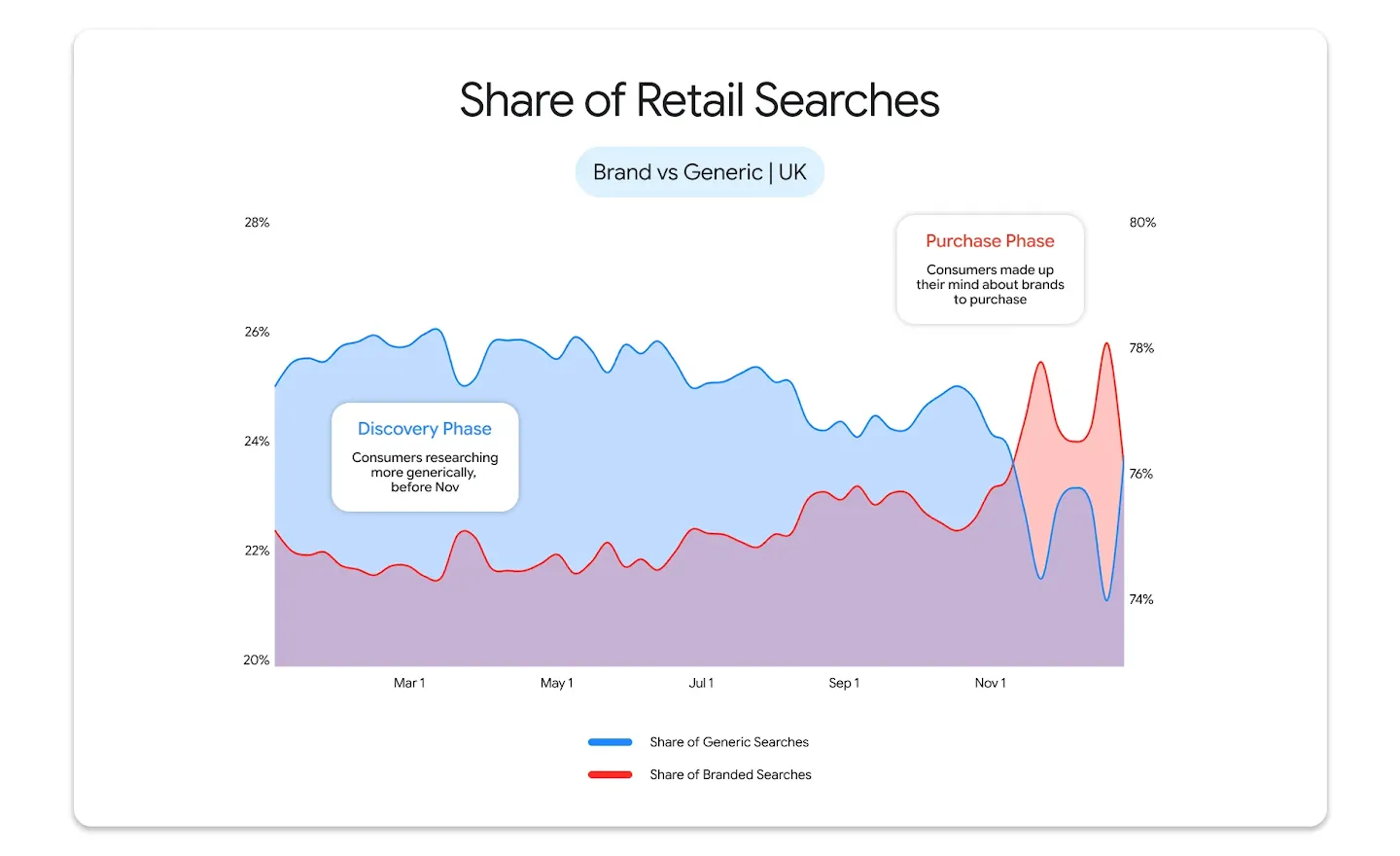
Image Source: Shared by Google with Premium CSS Partners based on Google Internal Data | Apparel, Athletic Shoes, Beauty & Personal Care, Computers & Consumer Electronics, Fashion Designers & Collections, Food & Groceries, Health, Home & Garden, Occasions & Gifts, Sports & Fitness Apparel, Toys & Games
Key Peak Season Insights & EMEA Retail Benchmarks
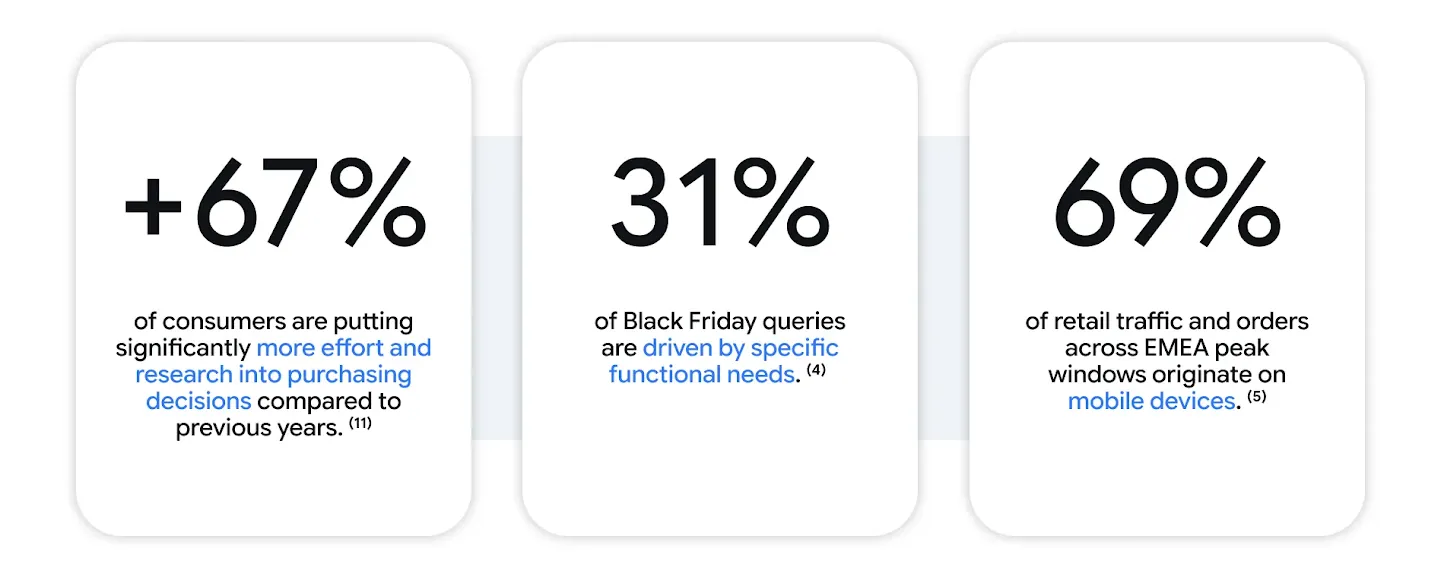
Google data reveals that +67% of consumers are putting significantly more effort and research into purchasing decisions(3) compared to previous years. Early search volume peaks as early as late October for categories like Apparel, Electronics, and Home.
Another shift that will mark this year’s peak season is the focus on functionality, instead of pure discount intent:
Search behavior across EMEA shows that over 31% of Black Friday queries are driven by specific functional needs (e.g., replacing broken appliances, or changing sizing/compatibility) rather than simply chasing discount opportunities. Search trends also revealed that clients are continuously looking for reassurance, as search interest containing queries with "reviews", "best", and "comparison" spikes by +30% to +40% YoY heading into Q4(4).
Those searches, as exemplified by 2025, show that over 69%(5) of retail traffic and orders across EMEA peak windows originate on mobile devices, where Google Lens, Visual Search, and short-form Video (YouTube Shorts) intersect with Shopping Ads results, making video and high quality images non-negotiable assets to master in preparation for the end of the year.
With such a huge variety of new formats and channels being leveraged between discovery and purchase, it’s not surprising that more informed decisions mean an almost threefold increase in the amount of touchpoints(2). This information overwhelm is driving customers to seek faster, more tailored answers to their queries, over multiple platforms across a longer timeline when compared to previous years. Essentially, AI helps synthesise this information into highly specific information on demand.
For merchants, this is a challenging combination to balance. Major scalability, while maintaining data depth, asset quality and a seamless and optimised path to purchase are key to stay on top of those needs. Luckily, we’ve got all the information you need to do just that.
The First Step and Foundation to Connect to This Year's Super Empowered Shoppers: Your Feeds Data and Merchant Center
As we’ve covered, in 2026 empowered shoppers will rely on AI to beat the holiday rush. From finding the perfect gift to snagging the best deal, and even handling the checkout, AI will be a guaranteed feature in many, many transactions.
Not to mention, as AI seamlessly blends speed with depth of information, the age-old trade-off between a smart decision and a fast one is no more. But how does this reflect on actual behaviors and your set up?
As shoppers grow used to sharper results as an output to more complex and detailed queries, merchants must focus on deeper, more complete, context-based data and Merchant Center hygiene and optimisation.
During Peak Season, where AI-influenced searches are 3x longer, 77% of users report making faster purchase decisions(2), while at the same time touching 2.8x(2) more touchpoints. With so many more interactions on the table, it’s easy to see how feed latency and data mismatches directly lead to lost revenue.
An optimised and polished Feeds Data foundation can help you cut through the highly competitive seasonal landscape to connect to high-intent users.
Feed Architecture & Optimisation Checklist
1. Feed Preparation & Launch Timelines
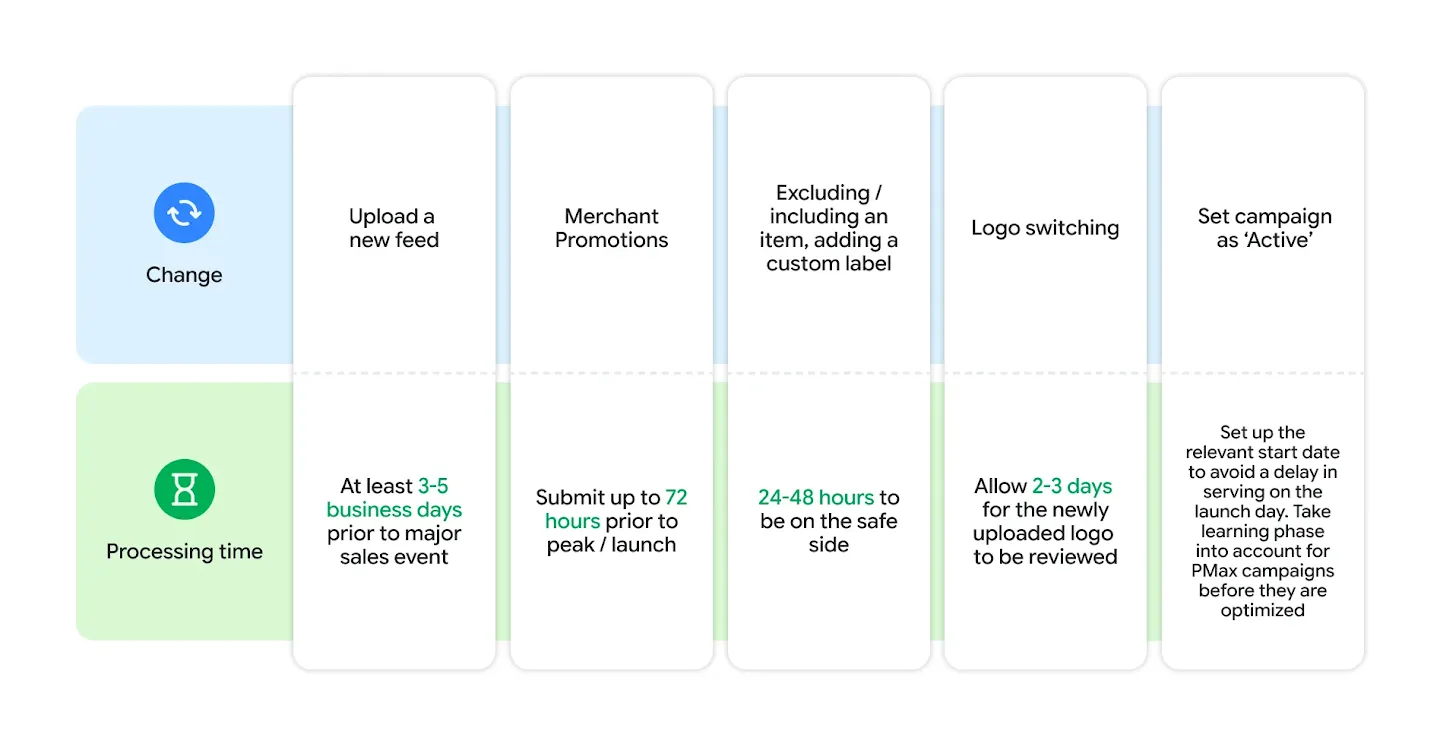
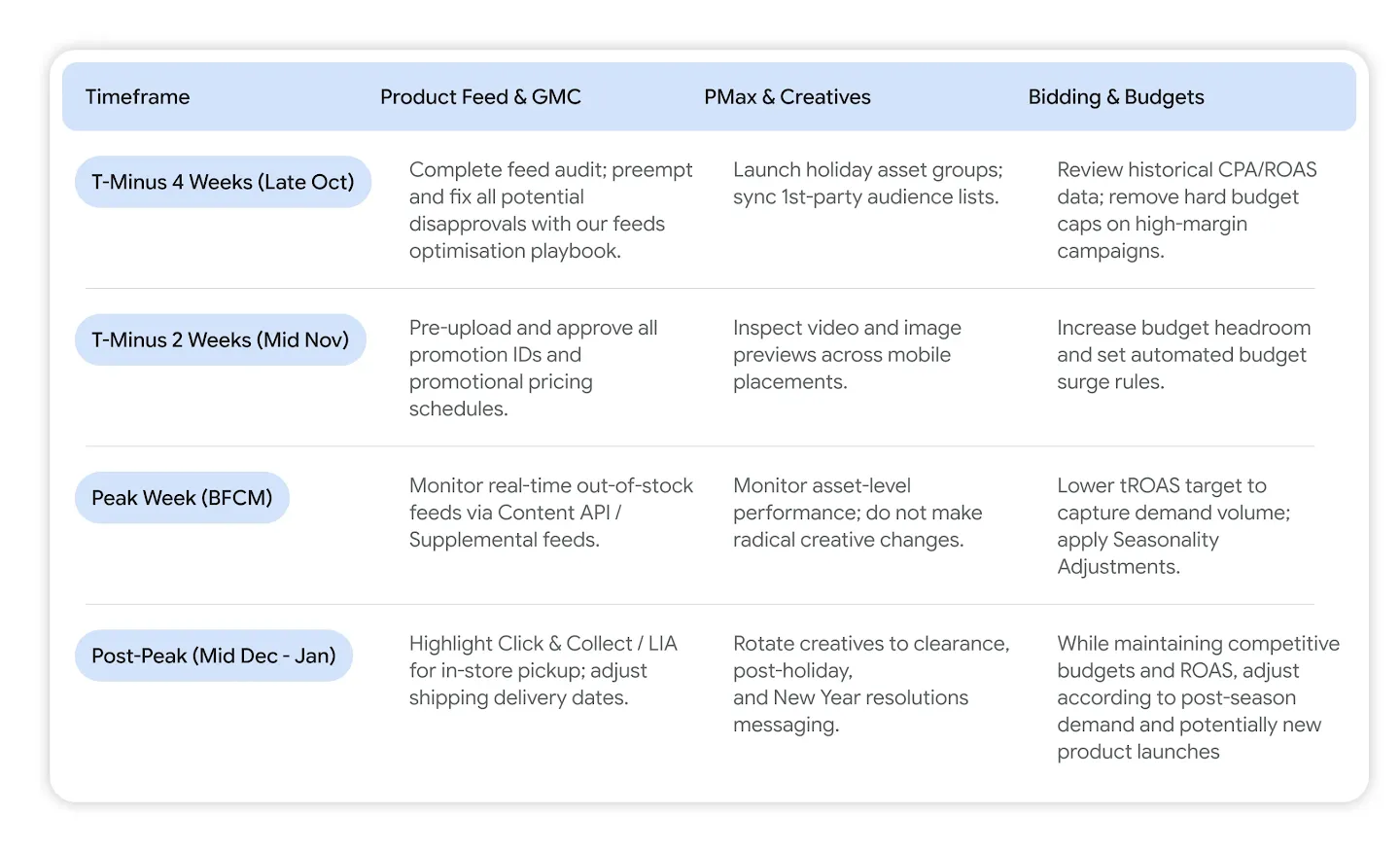
Flawless execution during peak moments begins with respecting platform review and processing buffers. See below a suggested timeline get your Feeds and Google Merchant Center ready ahead of the peak season(6):
2. High-Impact Promotional Mechanics
Structure promotional incentives around clear, easily digestible offers that appeal directly to price sensitivity. Align your retail push with four primary promotion formats:
- Direct Price Reductions: Apply straightforward cash savings (e.g. minimum €5 off), tiered spend thresholds or cashback and rebates.
- Percentage Discounts: Run flat rate-offs, tiered percentage bands, or multi-buy volume deals like "Buy one, get one free" or "Buy one, get the second at a discount".
- Shipping Incentives: Offer free shipping to eliminate standard checkout friction and reduce cart abandonment.
- Gifting & Rewards: Add value without eroding price perception by pairing purchases with free gift items or future gift cards.
3. Boosting Visibility & CTR with Shopping Annotations
Visual badges and annotations provide crucial trust signals that can result in engagement and conversions uplift. Sale price badges, for example, can drive up to a 7.6% CTR uplift and a 12.3% conversion rate increase; while adding Product Ratings and Free Shipping & Shipping Speed, can provide a 5% CTR uplift(7), not to mention the positive impact it can have on conversion rate increase. Lastly, configuring a clear 30-day Return Policy can deliver a 3% uplift in conversion rate and conversion value(7).
4. Local Inventory Ads (LIA) — Focused Overview:
LIA offers two tailored solutions to rescue sales and drive store volume:
- Pick Up Later promotes products available in a few days, which can deliver an 11% increase in clicks, a 17% CTR uplift, and a 20% reduction in omnichannel cost per conversion(8).
- Pick Up Today highlights immediate in-store availability, which can drive a 20% increase in store visits, a 20% lift in CTR, and a 16% increase in omnichannel ROAS(8).
Increasing Your Reach and Presence with Performance Max (PMax) Campaigns & Creative Asset Groups
Maximising peak season means being present across as many touchpoints as possible, while still maintaining tailored and high-quality results to communicate with this year's high-intent (and highly demanding) shoppers.
Being able to identify the sweet spot to cut through the noise and be visible when it matters most can make or break your end of year season. One of such sweet spots is November: when discovery turns into purchase intent, so make it count:
- Until the end of October, searches are notably more generic. Around the first week of November, however, there’s a clear shift(10) where consumers have seemingly made up their minds about which brands to purchase from and are now ready to start digging into specifics.
- It's critical to allocate more budget in your Shopping Ads and have flexible bidding strategies in place(10). If your campaigns are constrained, you could have a leaky funnel and you'll miss out to competitors on capturing these high-intent shoppers as they move closer to purchase.
As we head towards an AI-first landscape and, consequently, an AI-driven peak season, Performance Max continues to be at the centre of your multichannel strategy, because reaching all of them becomes an imperative. This year’s peak season requires your account and asset structure to reflect the broad but specific demands of such users.
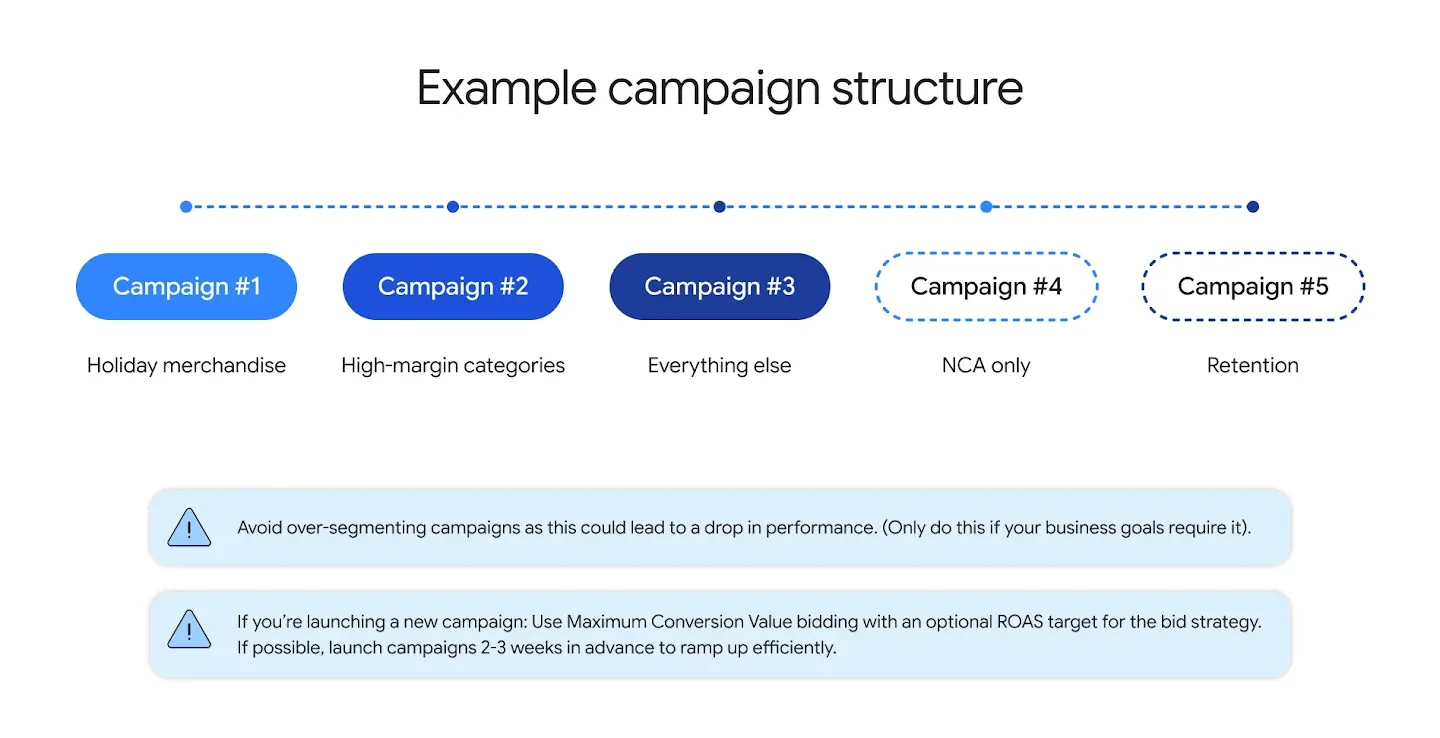
What does this mean for you? Seasonal Campaigns can help you be intentional about your budget, business goals and specific holiday season strategy. The same rationale cascades to your asset groups: structure them strategically and intentionally by business objectives and with specific holiday offerings top of mind, while maintaining rich creative inputs. Finally, ensure a well thought through Performance Max strategy to bridge the connection between your user and your purchase page.
Peak specific Asset Group Strategy & Campaign Architecture
As you can see in the diagram above, a resilient creative strategy pairs seasonal bursts with always-on assets to sustain demand year-round. To win attention across competitive placements, prioritise high-resolution visuals, short-form vertical video, and punchy hooks.
Relevance, however, requires looking beyond visual polish to genuine local resonance and clear value. Scaling effectively demands authentic localisation over direct translation. Tailor imagery, cultural nuance, and value-driven messaging to each market so discerning shoppers immediately understand the product’s benefits and feel confident converting.
Campaign Optimisation Checklist
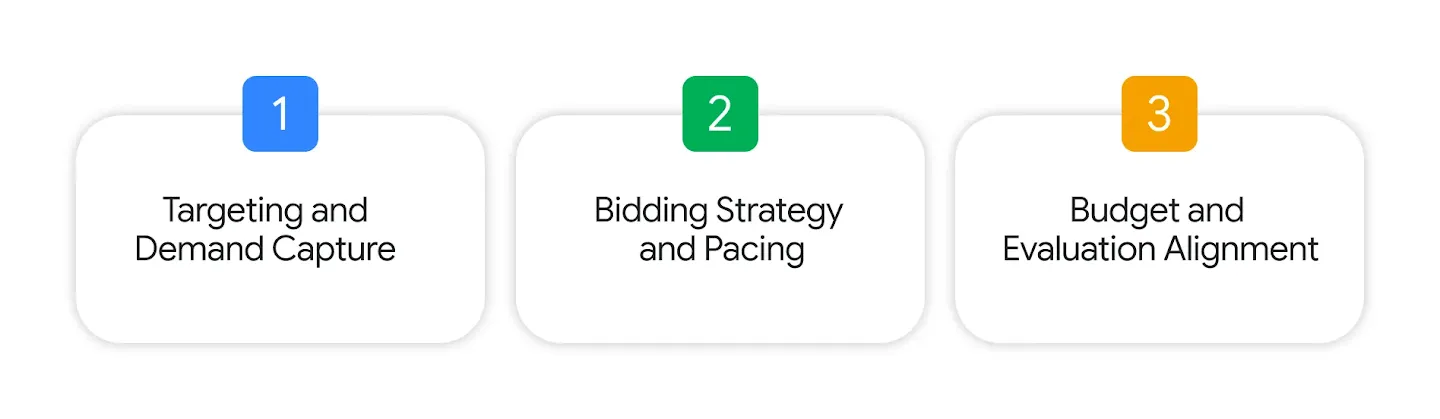
- Targeting & Demand Capture
Enable Final URL Expansion to automatically capture unexpected search queries and route shoppers to the most relevant landing pages, while leveraging New Customer Acquisition (NCA) modes to prioritise first-time buyers and balance immediate conversions with long-term customer value. - Bidding Strategy & Pacing
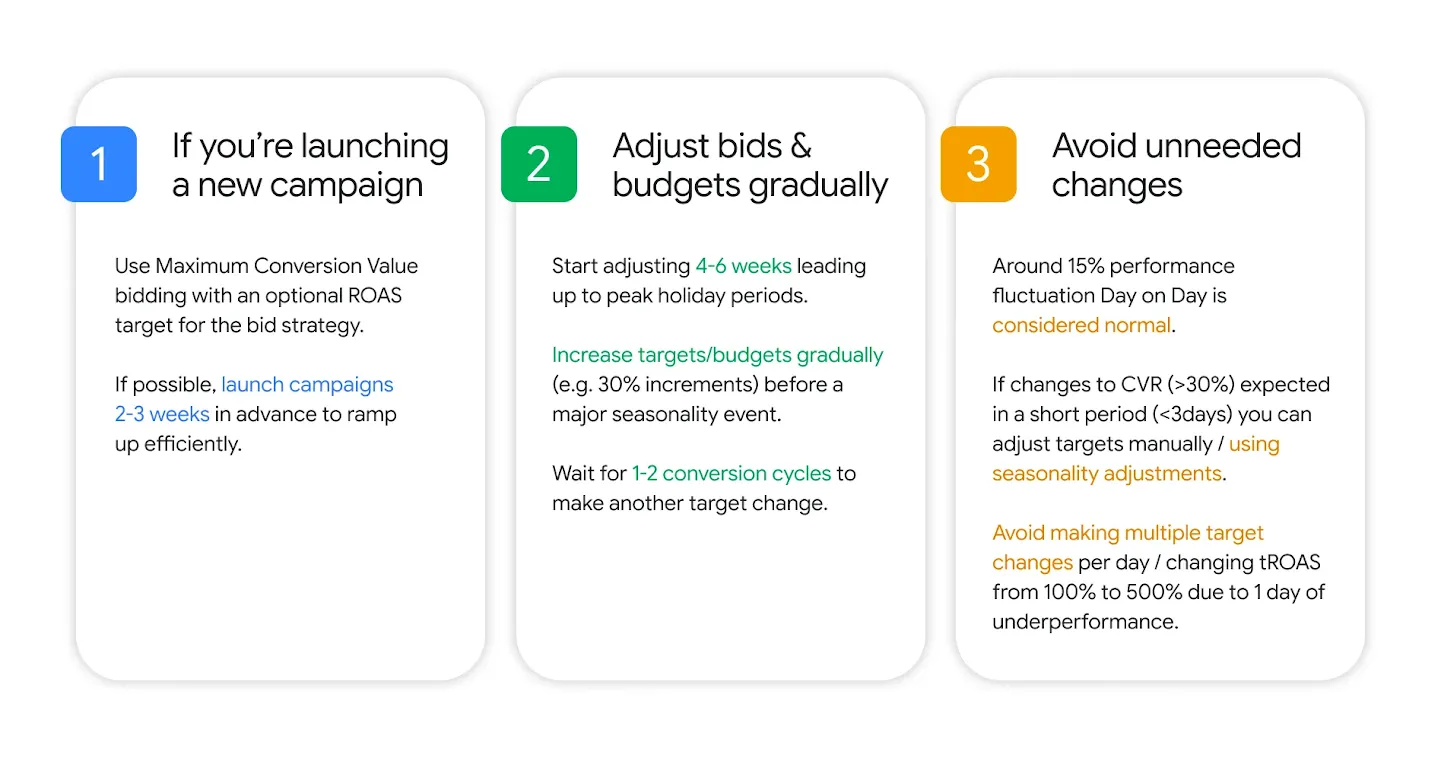
When it comes to bidding, gradual changes and patience for results and performance to stabilise are paramount. Start adjusting bids and budgets gradually 4 to 6 weeks before peak holiday periods. When optimising targets, avoid drastic shifts: limit bid adjustments to 5–10% (maximum ±15%). Reserve manual overrides or seasonality adjustments strictly for short periods where conversion rates are projected to swing by more than 30%. - Budget & Evaluation Alignment
Because major budget updates trigger algorithmic recalibration, allow performance metrics roughly a week to stabilise before making further changes, and measure overall success strictly against your core bid strategy goals, rather than isolated vanity metrics.
Bidding & Budget Strategy: Demand-Led Scaling
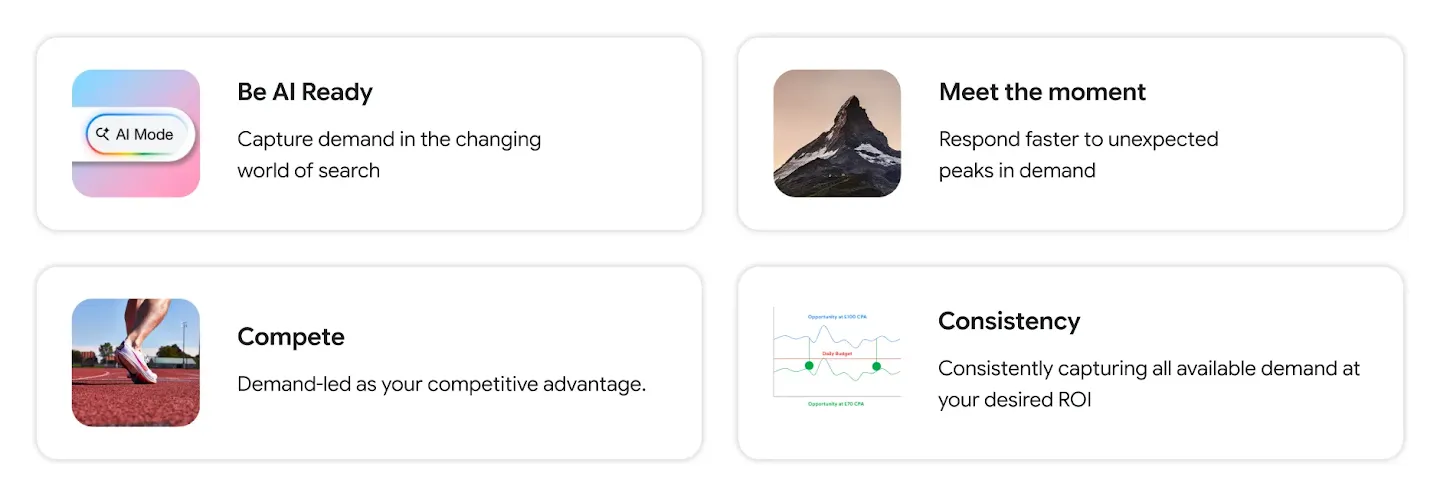
Peak season demand fluctuates sharply from early November through late December, making static budgets and rigid ROAS targets a major constraint during sudden traffic surges. Adopting a demand-led budgeting strategy removes these artificial caps, allowing you to dynamically align spend with real-time consumer intent and capture high-converting shoppers before competitors get a chance to react.
Beyond short-term agility, this responsive approach functions as a sustained competitive advantage. By transforming your budget from a restrictive ceiling into a flexible, ROI-anchored growth driver, campaigns can capture all available market demand efficiently and maximise profitable revenue throughout the holidays.
1. Demand-Led Bidding Strategy
- Lower Target ROAS (tROAS) During Peak Days:
Conversion rate (CVR) and conversion intent rise significantly during peak events. Loosening and increasing flexibility on your tROAS allows Google AI to bid aggressively on high-converting auctions that would otherwise be rejected under strict efficiency thresholds. - Max Conversion Value vs. Target ROAS:
If your goal is total revenue or clearing inventory over a 72-hour flash sale, temporarily switch from Target ROAS to pure Maximise Conversion Value with an uncapped/expanded budget.
2. Strategic Use of Seasonality Adjustments
Apply Seasonality Adjustments 48–72 hours before launch exclusively for short, infrequent promotional spikes lasting under 7 days where a temporary, significant conversion rate surge (e.g. over 30%) is anticipated. Input the exact sale dates and expected CVR lift to allow Smart Bidding to bid aggressively for the duration without distorting historical models.
3. Budget Management
Adopt a demand-led budgeting framework by keeping campaign daily budget utilisation strictly below 90%. More than 60% of Google performance campaigns use demand-led budgets(11) to stay open to surging search interest round-the-clock without hitting artificial daily spend caps.
Key takeaways:
Give yourself the gift of peace of mind this season
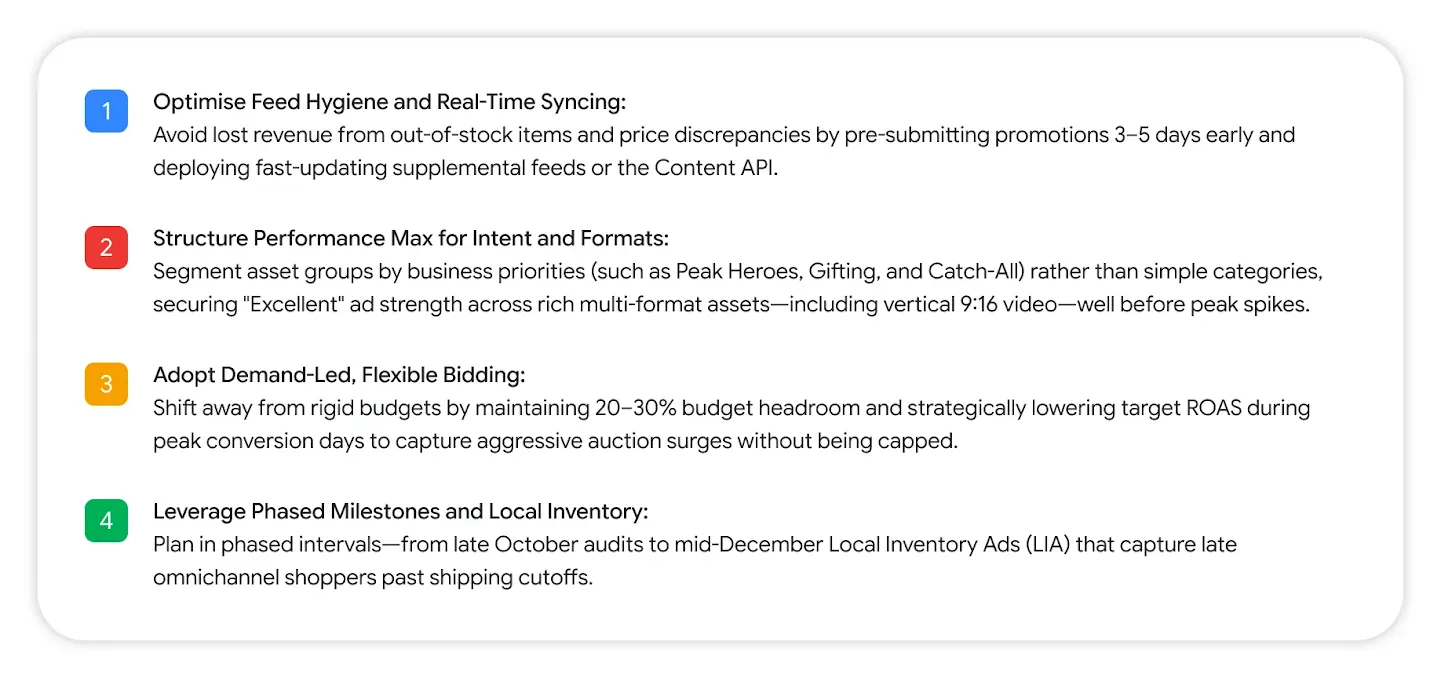
This holiday season will be won on trust, scalability, depth and agility. As the old seasonal peak transforms into an extended, non-linear corridor driven by research-heavy, AI-empowered shoppers, winning in Q4 requires shifting from rigid setups to real-time agility across data, creatives, and bidding. Keep these summaries handy for the coming months:
Ultimately, preparing for success in an AI-first shopping landscape depends on replacing static ceilings with dynamic responsiveness. By pairing a flawless, real-time product data foundation with flexible budget and bidding strategies, you can work the landscape to your advantage and capture high-intent demand across every stage of the extended holiday journey.
With that, all that’s left to do is wish you a very happy peak season!
Sources:
1) Shared by Google with Premium CSS Partners, based on Google internal data referencing click volume, Sept–Dec 2026 vs. same period previous year (2025) | Categories: Top retail categories (Apparel, Beauty & Personal Care, Computer & Consumer Electronics, Food & Groceries, Home & Garden, Occasions & Gifts, Retailers & General Merchandise) | Country considered: EMEA countries
(2) Google commissioned Ipsos Global Consumer Journeys, Dec 2025, research shared with Premium CSS Partners; Online Survey, Global average of select countries (AR, AU, BR, CA, CL, CO, DE, ES, FR, ID, IN, IT, JP, KR, MX, NL, PE, PH, PO, SE, SG, TW, TH, US, UK) adults 18+ online shoppers who made a consumer good purchase in the past week using Google AI Overviews and AI Mode for shopping.
(3) Google commissioned Ipsos Holiday Shopping, Oct 2025–Jan 2026, research shared with Premium CSS Partners; Online Survey, US consumers 18+ who conducted Holiday shopping activities in the past two days (Specific breakdowns: n=6,122 who shopped in-store; n=1,452 who used Google Search with AI features vs. n=2,728 who used Google Search without AI features).
(4) Google commissioned Ipsos Holiday Shopping, Oct 2025–Jan 2026, research shared with Premium CSS Partners: Online Survey, US consumers 18+ who conducted Holiday shopping activities in the past two days (n=8,237 total; n=1,119 who use both Google Search and YouTube)
(5) Shared by Google with Premium CSS Partners, based on Google Internal Data from 2025
(6) Shared by Google with Premium CSS Partners based on Google Internal Data.
(7) Shared by Google with Premium CSS Partners, based on Google Internal Data from January through August 2025.
(8) Shared by Google with Premium CSS Partners based on Google Internal Data; benchmarks compared to regular Shopping Ads.
(9) For 73% of US holiday transactions in physical stores: RetailDive, Visa, Mastercard Track roughly 4% US Holiday Retail Sales Growth, Jan 6, 2026 For 81% consulting Google/YouTube: Google commissioned Ipsos Holiday Shopping, Oct 2025–Jan 2026, Online Survey, US consumers 18+ who conducted Holiday shopping activities in the past two days, n=6,122 who shopped in-store For 85% using Google Search with AI features in-store: Google commissioned Ipsos Holiday Shopping, Oct 2025–Jan 2026, Online Survey, US consumers 18+ who conducted Holiday shopping activities in the past two days, n=1,452 those who used Google Search with AI features vs. n=2,728 those who used Google Search without AI features
(10) Shared by Google with Premium CSS Partners based on Google Internal Data | Apparel Athletic Shoes, Beauty & Personal Care, Computers & Consumer Electronics, Fashion Designers & Collections, Food & Groceries, Health, Home & Garden, Occasions & Gifts, Sports & Fitness Apparel, Toys & Games.
(11) Shared by Google with Premium CSS Partners Google Internal Data, Global, May 2025–April 2026. Includes Search, Shopping, and Performance Max campaigns by count. ("Demand-led" defined as campaign daily budget utilization below 90%)