

Feed Optimisation in the AI-Driven Commerce Era: Enabling Growth Today, Preparing for Tomorrow
By the Google Shopping (CSS) Team | Expertise series [July 2026]
Artificial intelligence is driving a major structural evolution across the global retail market. McKinsey projects that by 2030, agentic commerce could account for between $3 trillion and $5 trillion in global B2C retail market revenue¹. Make no mistake, this is a paradigm shift. Retailers must now plan for two distinct customer types:
- The Human Customer: People are driven by emotion, visual appeal, and social proof. They require immersive interfaces, rich media, and frictionless UX.
- The Machine Customer: Driven by logic, speed, price-performance ratios, and structured data availability. They require robust APIs, "agent-ready" catalogs, and programmable logic.
The embedding of AI throughout the journey to purchase is a fact of life for consumers, too. AI has transformed how people approach complex decision making while shopping. Take Google Search, which has now become the place where people figure out what they want by a process of refining and exploration; not simply an engine for finding what they're looking for. In fact, 71% of shoppers agree they are open to trying new brands or products when searching².
By shifting from traditional keyword queries to conversational prompting for highly specific, multi-criteria needs, consumers can now leverage Google’s "AI Mode" and AI Overviews to surface tailored recommendations and interactive answers. Ultimately, this agentic AI can empower retailers to actually make shopping easier; maximising conversions by intelligently matching customer needs to product specifications.
To navigate the agentic transition, you need a strategy that locks in wins today while capturing the automated shopping behaviors of tomorrow. To help you drive growth right now, while also future-proofing your business, the Google Shopping (CSS) team mapped out the following framework.
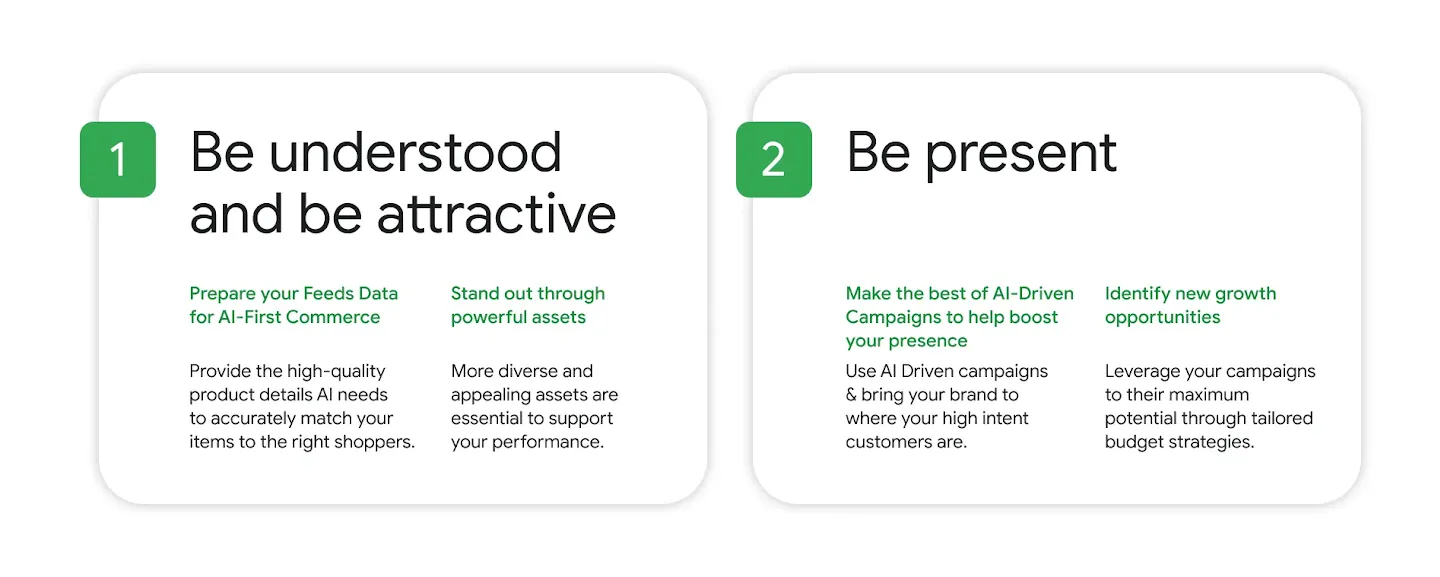
While expanding your campaign presence is important, today we are focusing entirely on the foundational step of making your brand understood and attractive to shoppers, and that starts with your data. Feeds are the backbone of this entire framework, so we’re going to dive deep into how to master them in this playbook.
Mastering Feed Optimisation Foundations to Fuel AI-Driven Commerce
First, let’s explore a critical factor that's often overlooked but more essential to campaign success than ever. Optimised feeds are the most powerful growth lever in the AI-driven commerce era. Concretely, having complete, accurate and optimised product data helps to influence the ad auction and drive traffic with Shopping or Performance Max (PMax) campaigns. Feed health serves as the fuel for the AI's logic, allowing AI agents to understand user intent and match it to the perfect item. To prepare your data for this evolution, focus on these four core actions:
- Maximise AI surface area through scale: Ensure your entire catalog is approved and available to give AI agents more opportunities to discover your products.
- Enrich your feed with data: Refine titles, descriptions, and images to provide the high-quality data that drives better AI performance.
- Treat your feed as a living engine: Keep your feed dynamic rather than static, continuously refining it to keep pace with evolving AI models.
- Optimise your landing pages: Match landing page data to your feed at all times, adding structured data to give crawlers more product context and prevent disapprovals.
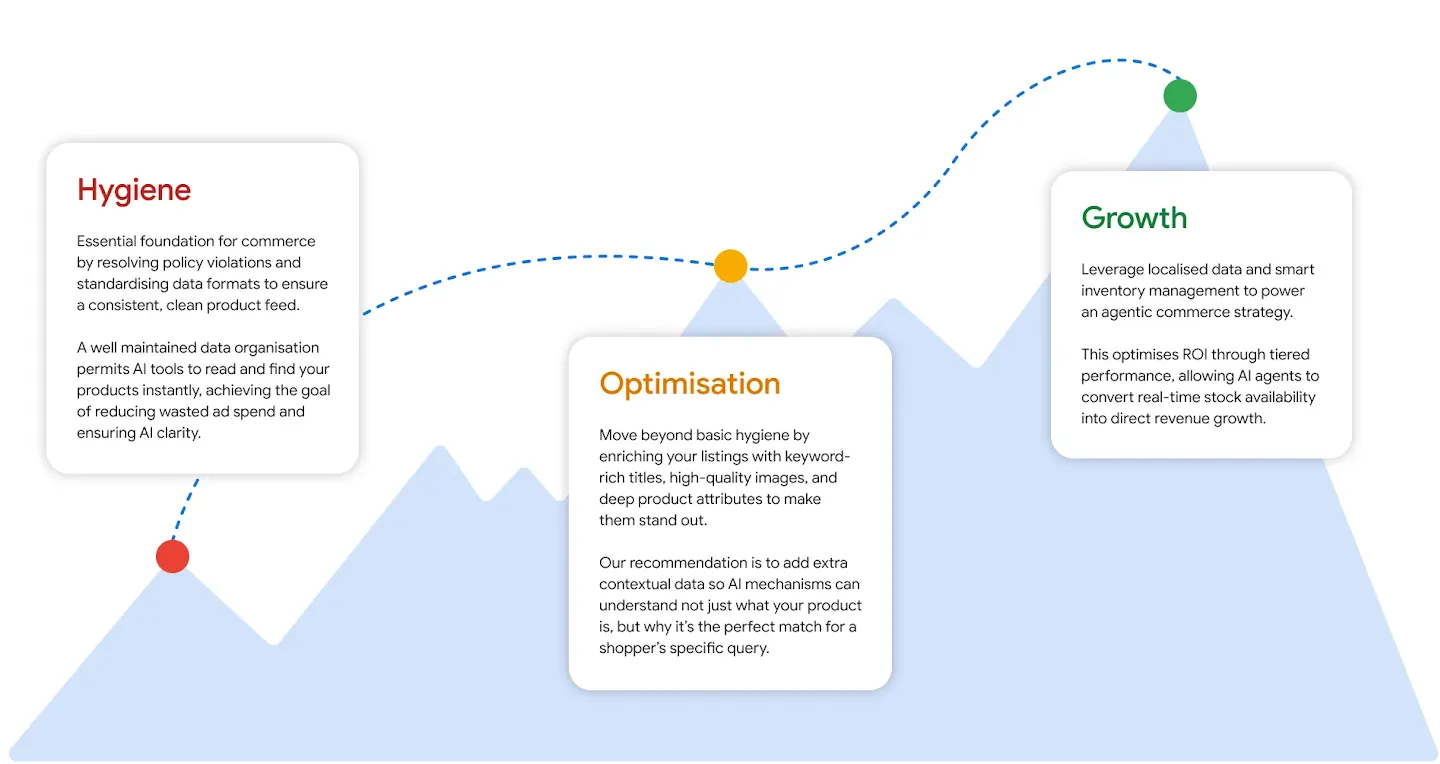
Mastering these four actions sets you up for a clear, three-stage Feeds Maturity journey, moving from Hygiene to Optimisation, and finally to Growth, to completely solidify your foundational data.
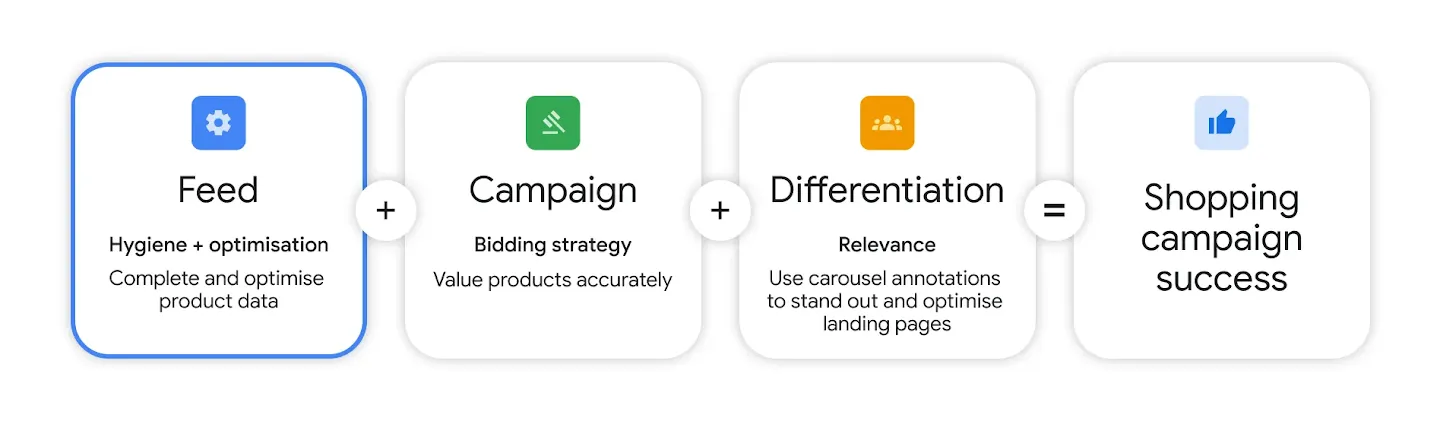
Once your feed is stabilised, it plugs directly into a wider ecosystem where high-quality product data, smart campaign bidding, and tailored differentiation all work together to drive your shopping success. Feed optimisation ensures you are winning more bidding auctions. By providing enriched, high-intent data, you help AI agents to recognise your products as the best possible match and prioritise them for the consumer.
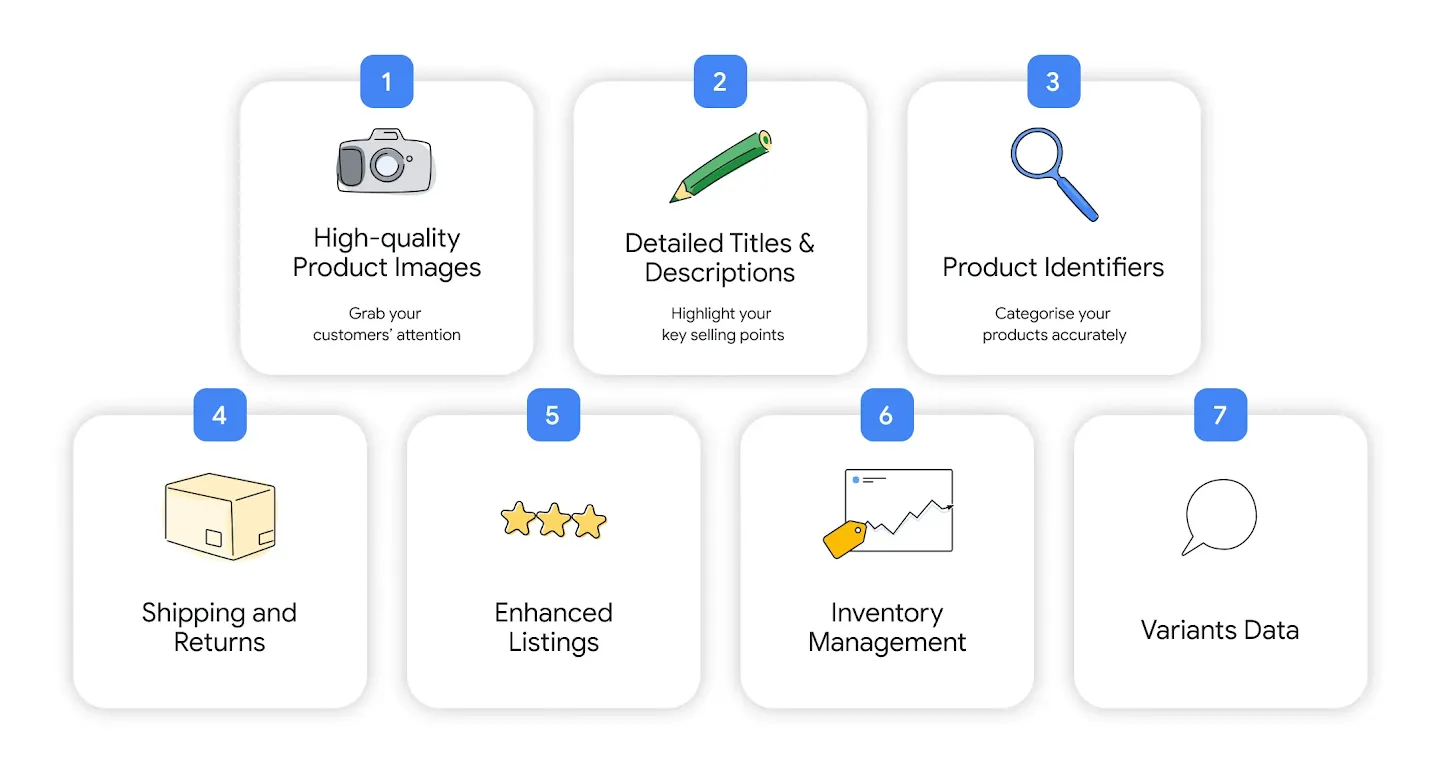
Maximising the power of your feed doesn't happen by accident—it requires fine-tuning the specific details that shoppers notice first. At Google Shopping (CSS), we help thousands of merchants across Europe to optimise their campaigns. We’ve distilled our knowledge and experience into seven powerful feed optimisation levers that will help you grab attention, establish relevance, and ultimately drive high-intent traffic to your site. Ready to take a look?
📷 Lever 1: High-Quality Product Images
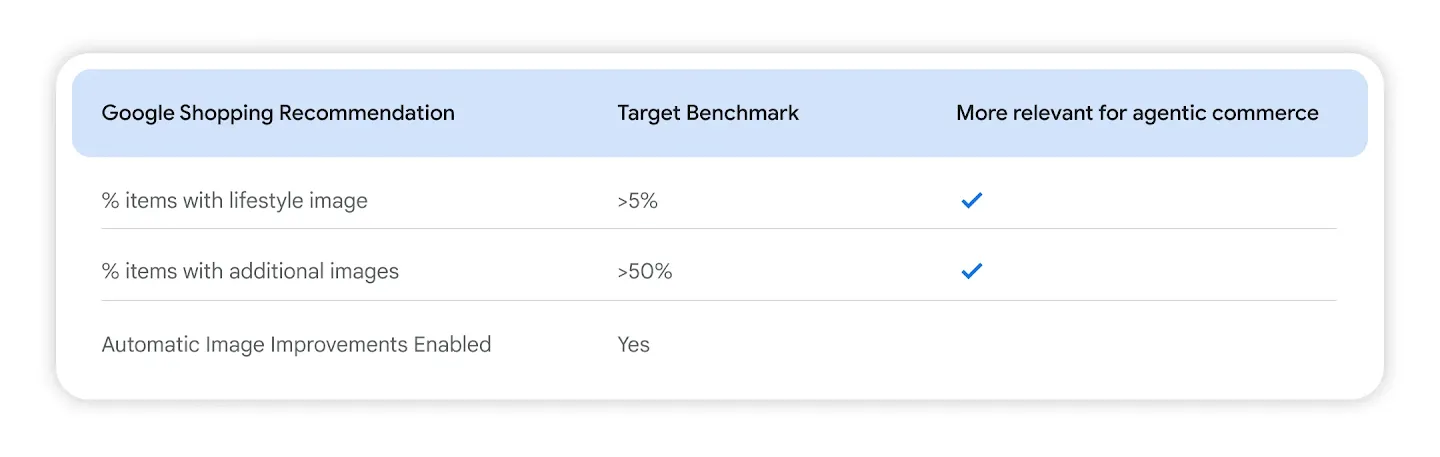
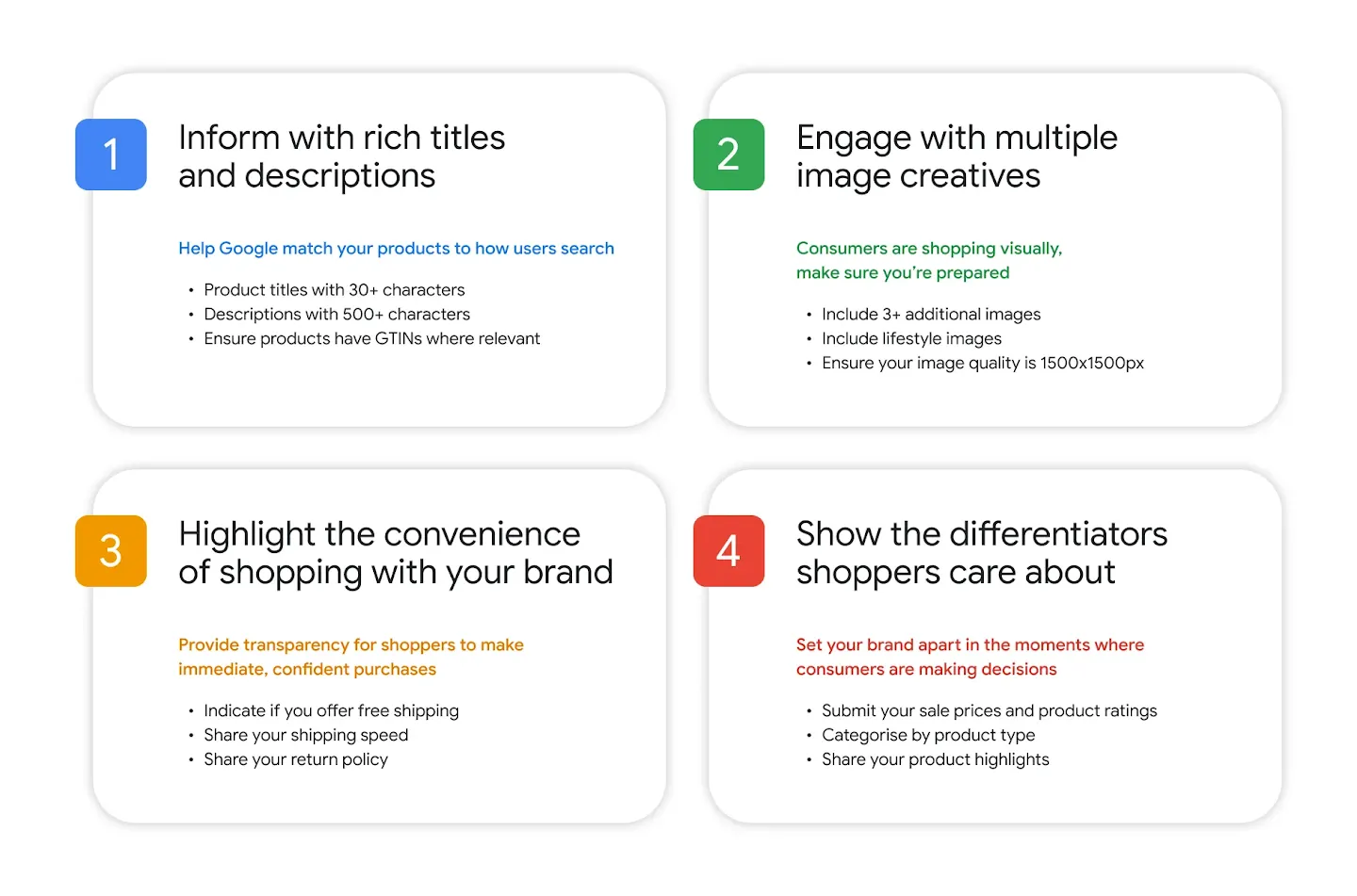
We live in a highly visual world. Your images are a shopper's first point of contact and quality can heavily influence initial click rates. Make sure to accurately showcase the product you’re selling with multiple, diverse, high-resolution images. To get there, tools like Product Studio can instantly upgrade your visuals by enhancing image resolution and removing distracting backgrounds. The Google Shopping (CSS) team recommends that more than 55% of your items are with image quality (>= 1500x1500 px).
📝 Lever 2: Detailed Titles & Descriptions
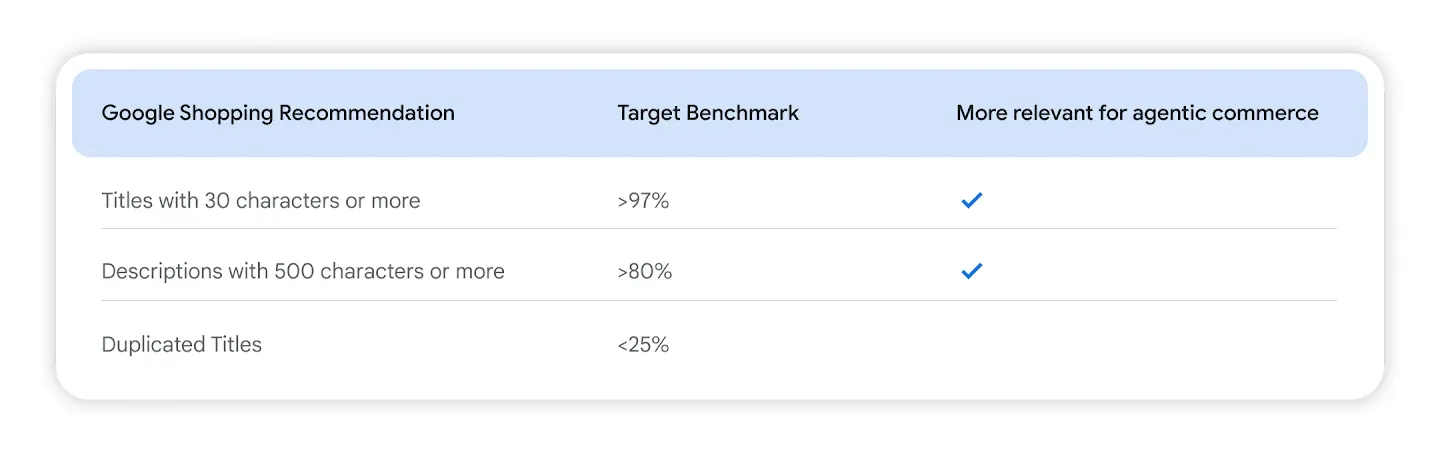
Optimised text fields match user queries accurately, preventing truncation in carousels and maximising ad impressions. Tools like FeedGen can help, think of it as your backend tool designed specifically to optimise feeds using Generative AI.
Key tip: Put your absolute best selling points at the beginning of the title. Incorporate hidden details (e.g., recycled materials) into your descriptions, and use search term reports to continuously align your copy with real customer language.
🏷️ Lever 3: Product Identifiers
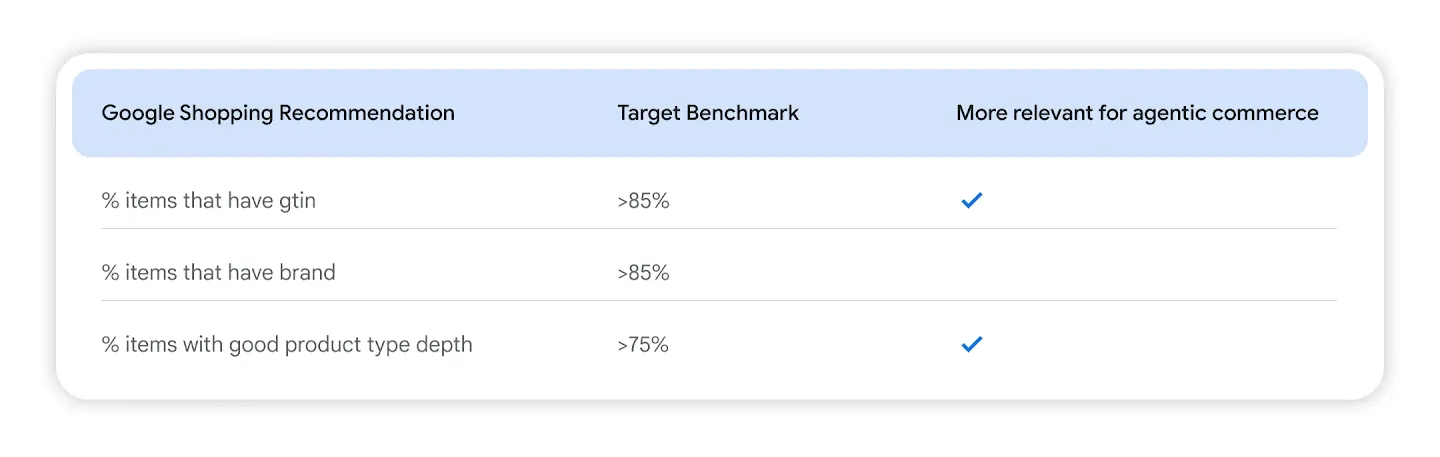
Valid identifiers are the digital backbone of your catalog, allowing Google to accurately classify and target your products.
Key tip: Always map genuine GTINs directly from the product barcode. If you manufacture your own products, use your official store name as the brand attribute.
🚚 Lever 4: Shipping and Returns
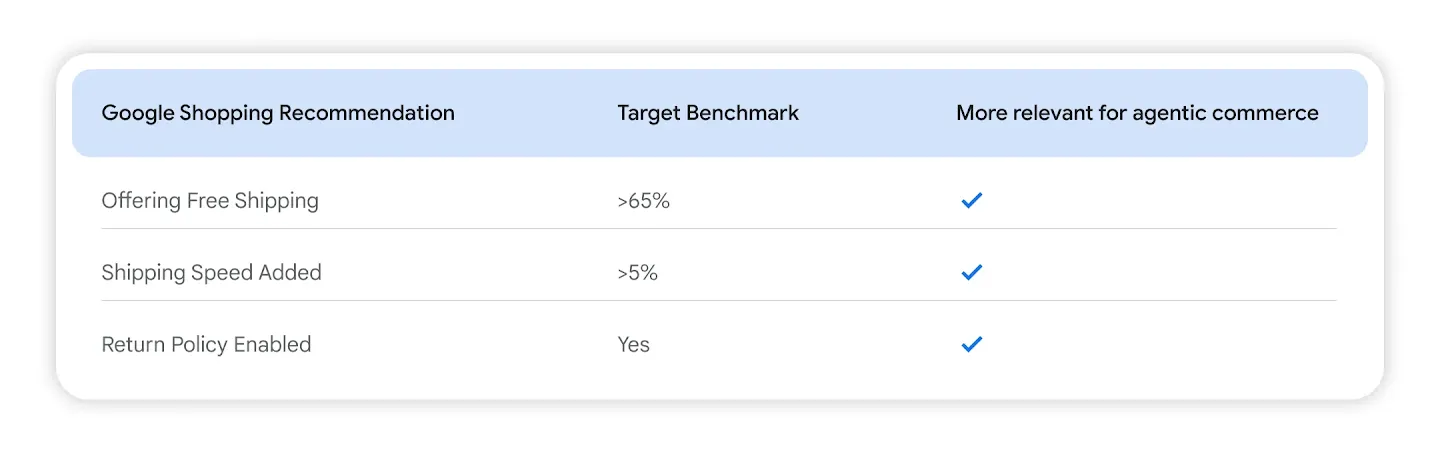
Transparent, competitive operational policies clear purchase friction and aggressively drive conversion value.
Key tip: Define your account-level rules for basic settings (like free shipping over a certain order value), and use item-level labels if you run specific product exceptions. Ensure Googlebot can crawl your checkout and policy pages to verify fulfillment speeds.
✨ Lever 5: Enhanced Listings
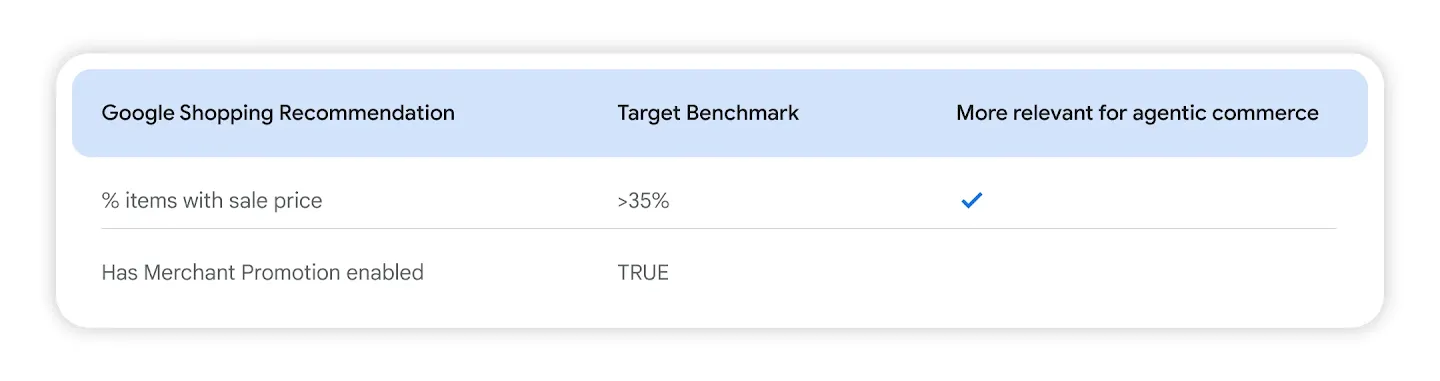
Promotions, clear sales pricing, and review stars elevate your standard listings into high-converting real estate.
Key tip: Use the Merchant Center 'Marketing' tab to sync active business promotions, and activate the 'Analytics' tab to aggregate star ratings.
📈 Lever 6: Inventory Management
Total catalog coverage ensures you don't accidentally drop high-margin or best-selling SKUs from active bidding.
Key tip: Regularly check for catalog drop-outs caused by attribute changes. The Google Shopping (CSS) team highly recommends deploying a catch-all campaign alongside your structured groups to catch orphaned items, capture missed traffic, and simplify overarching inventory monitoring.
To optimise your feed effectively, we recommend aiming for a benchmark target where more than 95% of your products are actively targeted within your Shopping or Performance Max (PMax) campaigns.
👕 Lever 7: Variants Data

Granular variation metrics enable complex filtering, allowing shoppers to discover specific styles and configurations instantly. If your primary data lacks these isolated variant attributes, set up automated Merchant Center feed rules to parse and extract colors, genders, or sizes directly from your existing titles and descriptions.
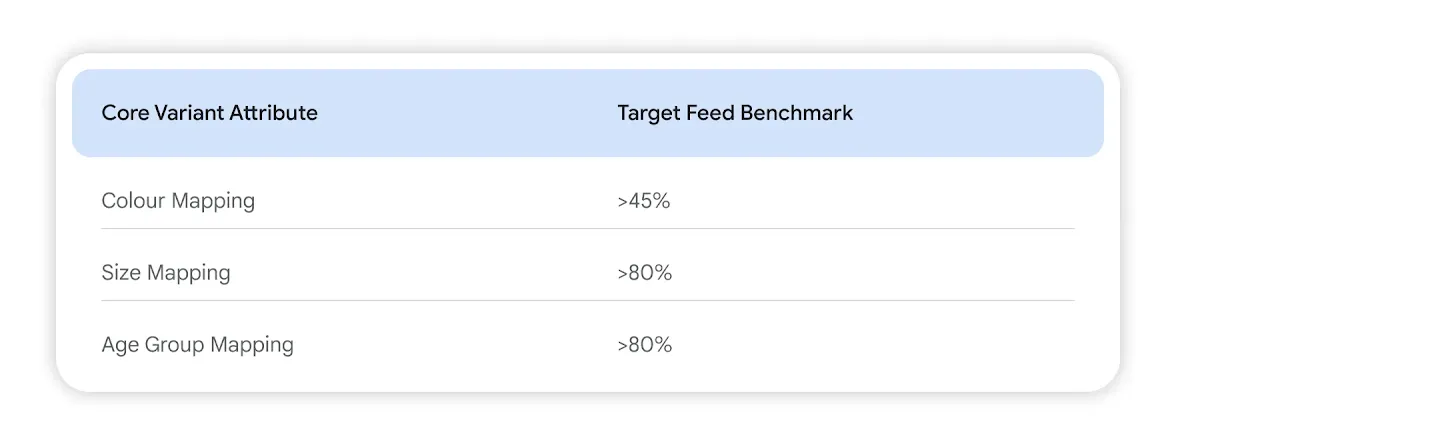
By leveraging these seven levers and following our optimisation recommendations, you can fundamentally improve how Google understands, classifies, and targets your inventory, which ensures your products are matched to highly relevant customer queries.
Ultimately, executing on these data points builds transparency and trust directly within the search results, which could drive massive performance uplifts. To give you an example, offers with more than one image see a 76% average increase in impressions and a 32% increase in clicks³. The framework below highlights the top feed optimisation strategies essential for success in today's AI-driven commerce landscape.
While mastering these foundational data points should be your first priority, Google is already building the next generation of tools to help you take feed optimisation even further. Here’s a peek behind the curtain:
Google’s Upcoming Innovations: Future-Proof Your Feed
Looking ahead, AI commerce trends will continue to transform the way product feeds are optimised. At Google Marketing Live (May 2026), Google unveiled a suite of next-generation AI tools designed to move backend data into interactive customer journeys. In this section, the Google Shopping (CSS) team have handpicked the ones we think will be most relevant for your feeds.
While these features are not yet widely available in all markets, including much of Europe, they highlight an exciting roadmap for future-proofing your feed. To see the latest rollout updates, check out Google’s latest announcements:
1. Conversational Attributes: Speaking the Language of AI
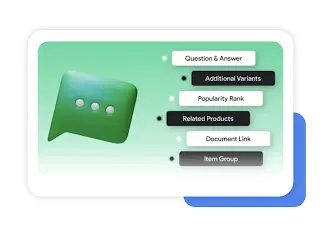
Google has globally launched six optional data feed attributes within Merchant Center: Question & Answer, Additional Variants, Popularity Rank, Related Products, Document Link, and Item Group. These attributes seamlessly integrate directly into your existing Merchant Center infrastructure, allowing Google's AI to dynamically answer complex, long-tail shopper intents with high-relevance recommendations.
2. New Universal Commerce Protocol (UCP) Powered Features: Achieving Zero-Click Conversions
The expansion of the UCP introduces next-generation features built to unify your retail surfaces for the agentic era. These capabilities enable native discovery-to-checkout journeys with flexible purchasing options, allowing shoppers to buy items in a few taps via Google Pay with top brands without leaving the interface, or seamlessly transfer their items to the merchant's site. It also includes the launch of Universal Cart, a unified cross-surface shopping hub across Google services that proactively tracks deals, price drops, and stock levels.
3. Ask Advisor for Merchant Center: Your Virtual Data Consultant
Shifting from dense diagnostics to conversational tech, Ask Advisor serves as a personal consultant that lives directly within your Merchant Center account, letting you use natural language to instantly diagnose catalog issues, resolve product disapprovals, and receive tailored performance insights.
4. Customer Lifecycle Solutions: Attracting High-Value Shoppers and Net-New Audiences
Google is introducing features built to maximise conversion value through smart lifecycle filtering and loyalty integrations. The system operates on two core pillars to deepen engagement with your highest-value shoppers: New Prospects Mode, which actively filters out existing customers to focus spend on net-new shoppers, and Loyalty Annotations, an update drives loyalty program enrollment by expanding dual-price annotations globally across free and paid listings. It attracts high-value shoppers by prominently displaying member-only pricing and savings alongside standard retail prices.
Fueling Retail Success in the AI-Driven Era
One thing is clear, the shift toward AI-first commerce is no longer a future prediction: it’s a live market reality. As shopping splits into serving both human shoppers looking for rich media and machine agents demanding structured data, your product feed must stretch to feed both sides a single source of truth.
By systematically leveraging the seven optimisation data levers and adopting next-generation AI tools, you can do more than just fix catalog errors. You can fundamentally transform your product feed into a dynamic asset capable of capturing real-time user intent, maximising auction visibility, and building consumer trust.
The roadmap is clear: fix your feed hygiene today, optimise for agentic experiences, and prepare your business to thrive in the retail landscape of tomorrow. We’ll be with you every step of the way.
Sources:
1McKinsey Report (2025), The agentic commerce opportunity: How AI agents are ushering in a new era for consumers and merchants
2Shared by Google with Premium CSS Partners - Google commissioned Ipsos Global Consumer Journeys, Dec 2025, Online survey, Global average of select countries (AR, AU, BR, CA, CL, CO, DE, ES, FR, ID, IN, IT, JP, KR, MX, NL, PE, PH, PO, SG, SW, TW, TH, US, UK) not weighted to reflect population size, Adults 18+, n=36,543 online shoppers who made a consumer good purchase requiring consideration in the past week (range of categories) and use Google Search
3Google Ads Help Center (2023), Multiply your holiday performance with new ads and insights features