


Pro-Tip:
1. In order to drive the strongest performance possible, you must be strategic about the scale (budgets) and efficiency (ROAS targets) that you seek from your campaigns. Remember budgets and ROAS walk hand in hand.
2. Lowering your tROAS can signal the AI to expand its reach and be more aggressive, unlocking more conversion volume and value.

Scaling Growth in the AI-First Commerce Era
By the Google Shopping (CSS) Team | Expertise series [April 2026]
The 2026 digital marketplace has reached a turning point. With AI models changing how users behave and search, the retailers winning today aren't just "running ads"—they’re adapting their communications to fit naturally within an increasingly complex world.
The AI-First Consumer & The "Agentic" Shift
By 2026, AI will transform the historical trade-off between speed and accuracy, enabling even complex purchases to be completed more quickly and confidently. Already, consumers are shifting from keyword searches to collaborative brainstorming, with 75% reporting higher confidence thanks to AI tools and 77% making faster decisions because of them.1 However, this is also making search terms more complex than ever:
"Find me a waterproof, ethically sourced winter coat for -20°C weather that fits a petite frame, stylish but that I can also wear casually."
The Burden of Choice in a Bifurcated Marketplace
Despite advancements in tools that allow users to find highly specific, niche results, 63% of them still abandon purchases when overwhelmed.2 To cut through the noise, brands must effectively communicate with AI models and the end consumer shifting behavior patterns by adapting data and campaign set-up:
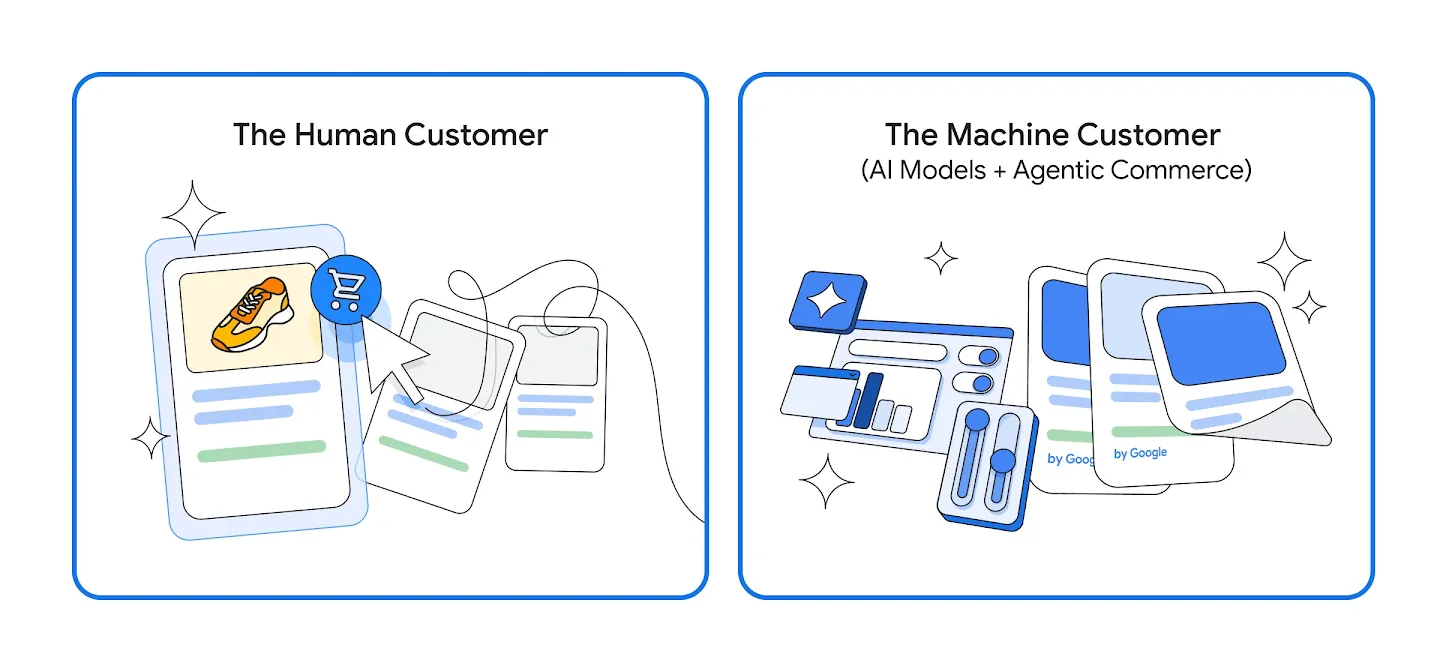
They spend 7x more 3 on brands they connect with. They value authenticity, real consumer testimonials, and immersive visual assets.
AI assistants go beyond recommendation: they research, compare price and performance, and finalize checkouts via protocols like Google’s Universal Commerce Protocol (UCP).
While understanding the changes in AI-first commerce is important, when built on high-quality feeds and assets,your budget and ROAS become your strategy's true accelerators. Optimized Feeds, robust and diverse assets and AI-driven campaign strategies remain the core foundations for a successful AI-first commerce strategy. When paired with tailored ROAS and budget strategies, these tools can unlock a new layer of performance. We’ll dive into three 'Strategic Levers' where balanced spending and targets can converge to drive your business goals.
The Strategic Levers for Scaling Reach in an AI-first Landscape
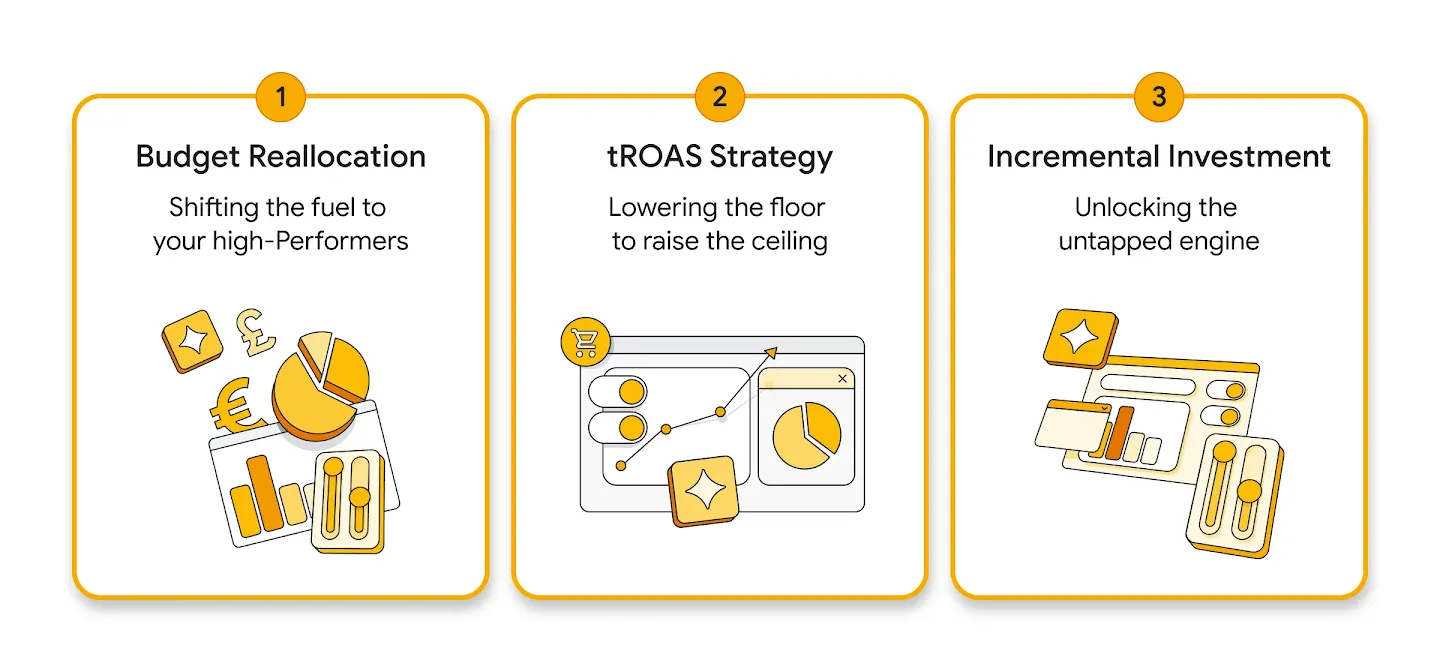
When focusing on smartly designing your ROAS and budget strategies, the Google Shopping (CSS) team identified three key ways to find new growth opportunities in your AI-driven campaigns:
1. Reallocation Opportunities: Shifting the Fuel to Your High-Performers
Many accounts suffer from "budget leakage", spending on campaigns that hit their targets but have no room to grow, while your true "winners" are starved.
- Underfunding your best-performing channels is handing customers to the competition. Audit your account for "budget leakage" and move that 10-15% of "lazy" budget to campaigns "Limited by Budget."
2. tROAS Opportunities: Lowering the Floor to Raise the Ceiling
A common trap is setting a tROAS that is too high. It may look great on a report, but it can act a "ceiling" that blocks the AI from bidding on high-volume, profitable sales at a lower but still profitable return.
3. Incremental Growth Opportunities: Unlocking the Untapped Engine
AI-driven commerce requires "fuel" to learn. Incremental investment is a strategic move to capture market share that manual bidding is unable to reach.
-
The Efficiency-First Growth Trap: If you only invest based on current efficiency, finding your next category leader can be more challenging. Use incremental budget to allow AI to find high intent users you aren’t currently serving or fund strategies like Tiered Testing, which the Google Shopping (CSS) team has found particularly relevant when helping clients grow efficiently. See an example slit of Tiered Testing below*:
- 70% Core Performance: Maintain your proven ROAS.
- 20% Strategic Growth: Lower ROAS targets to capture volume.
-
10% Experimental: Uncapped budget for new product launches or high-intent AI Mode queries and/or peak season.
*these values are not benchmarks and are displayed as example references only
Once you’ve ensured your ROAS and Budget are working together to help you unlock your growth potential, you just need to tailor your strategy to help you achieve your business goals:
-
Diagnose the plateau: If you’re hitting a "Scaling Wall," you’re likely stuck (e.g. when setting a target ROAS that is too high to achieve "Safe Efficiency") and are using the wrong levers to move forward.
-
Shift the levers, not just the spend: Growth isn't just about adding 10% more budget; it’s about changing the intent of that budget. Use your findings about the root cause of your plateau to design a tailored solution. For example, moving from Sustainable Profitability to Accelerated Expansion requires you to intentionally lower your ROAS "ceiling" and turn on URL expansion.
- Embrace the marginal ROI mindset: Instead of asking "What was my average ROAS?", ask "What was the ROAS on the last dollar I spent?" If your target is, for example, 500%, but you could get 20% more volume at a 450% ROAS, that is potentially a highly profitable expansion.
Growth is a Team Sport
In the Age of AI, all pieces of the puzzle matter to cut through the noise and drive growth. Your assets and campaigns will give you the power to adapt to communicate and reach users, wherever they are. Your feed is no longer just a file; it’s the instruction manual for Google’s algorithms. By combining a deep technical foundation with flexible and strategic budget levers, you can move beyond the "Burden of Choice" and get even closer to achieving your business goals and growth.
Sources
1source: ThinkWithGoogle, Google commissioned Ipsos Global Consumer Journeys, Dec 2025, Online survey, Global average of select countries (AR, AU, BR, CA, CL, CO, DE, ES, FR, ID, IN, IT, JP, KR, MX, NL, PE, PH, PO, SG, SW, TW, TH, US, UK) not weighted to reflect population size, Adults 18+, n=13,189 online shoppers who made a consumer good purchase requiring consideration in the past week (range of categories) and use Google AI Overviews and/or AI Mode for shopping
2source: Shared by Google with all Premium CSS Partners - Google/Ipsos partner research, Europe State of Retail Google/Ipsos research Europe (UK, FR, IT, DE, NL, ES), n=6000 online shoppers 18+.
3source: Source: Shared by Google with all Premium CSS Partners - Google/Ipsos partner research, The Relevance Factor, Mar 2026, Europe (UK, FR, IT, DE, NL, ES), n=6000 online shoppers 18+.